
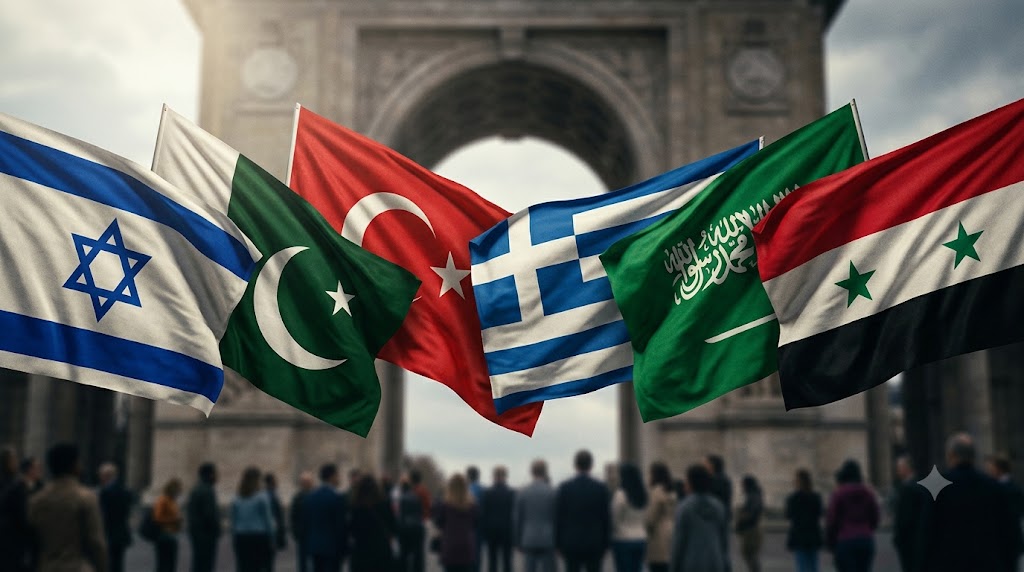
Turkey’s geopolitical position is changing faster than at almost any point in the last two decades.
On August 7, 2026, Turkey, Saudi Arabia and Pakistan signed the Mecca Joint Defense Agreement, establishing the principle that an armed attack against one would be regarded as an attack against all three. The agreement should not yet be confused with a NATO-style integrated military alliance, but its political meaning is difficult to ignore: Ankara is becoming part of a new regional security architecture.
At the same time, Turkey has been rebuilding its relationship with Egypt. The two countries signed a military cooperation roadmap in June, while Egyptian and Turkish forces have resumed increasingly substantive joint exercises.
Turkey has become one of the principal external actors shaping the new order in Syria. It has established a deep security, political and economic relationship with Somalia, where Turkish involvement has now expanded from military training and infrastructure into offshore energy exploration.
Relations with Iraq are improving. Ankara has also reopened channels with actors in eastern Libya rather than limiting itself to Tripoli.
Meanwhile, perhaps one of the most consequential developments is taking place inside Turkey itself.
A new legislative process aimed at completing PKK disarmament and facilitating the reintegration of former militants was submitted to parliament on August 5. Success is far from guaranteed, but if the process becomes permanent, one of Turkey’s longest-running domestic and regional security vulnerabilities could be significantly reduced.
Put these developments together and a larger picture appears:
Turkey is gradually reducing vulnerabilities while expanding its strategic reach.
The natural question is what other regional powers will do in response.
The wrong question, in my view, is:
Who will go to war with Turkey?
The more useful question is:
How would Turkey’s competitors try to slow this trajectory without going to war?
That distinction matters.
The most dangerous military fault line is Syria
I consider a direct war between Turkey and Israel highly unlikely.
Syria is the exception where miscalculation could create genuine military risk.
Turkey has a strong interest in a territorially integrated and increasingly stable Syrian state. A functioning Damascus can control borders, suppress non-state armed organisations, facilitate refugee returns and eventually participate in a broader Turkish-Iraqi-Levant economic system.
Israel looks at parts of the same picture very differently.
A consolidated Syrian state with a substantial Turkish military, intelligence and air-defence relationship could eventually limit Israel’s freedom of action over Syrian territory.
That creates conflicting strategic incentives.
Israel does not necessarily need Syria to collapse again. From an Israeli security perspective, a Syria that remains sufficiently decentralised, militarily constrained and unable to challenge Israeli operations may be preferable to a strong state closely integrated with Ankara.
The relevant tools therefore do not have to involve Israeli forces confronting Turkish forces.
Local actors can matter. Minority politics can matter. Security zones can matter. Airspace arrangements can matter. Pressure on Damascus can matter. And, above all, Washington can matter.
President Erdoğan himself said in June that Israeli military activity in Syria and Lebanon had reached a level that Turkey considered threatening to its own security.
This is therefore the area where two regional strategies can physically collide even if neither side wants a Turkish-Israeli war.
The danger is not a planned war.
It is an unplanned escalation.
Never underestimate Israel’s capacity for long-term preparation
There is another reason Turkish policymakers should think beyond conventional military scenarios.
Israel has repeatedly demonstrated its ability to prepare complex intelligence operations long before they are activated.
The 2024 pager operation against Hezbollah is an extraordinary example.
Explosives were incorporated into thousands of pagers that eventually entered Hezbollah’s communications system through what appeared to be an ordinary commercial supply chain. Reuters reported that the devices had been prepared months before their detonation.
The lesson for Turkey is not that Israel is preparing a similar operation against Turkey.
There is no evidence for such a claim.
The lesson is strategic.
Israel is capable of thinking in years rather than news cycles.
A country with that institutional mentality does not necessarily respond to Turkey’s growing influence by producing an immediate confrontation.
It can build relationships today that become strategically useful five years later.
That is why places that appear peripheral to Turkish-Israeli competition deserve attention.
Somaliland is an instructive example
Somalia has become one of Turkey’s deepest overseas engagements.
Turkey maintains extensive relations with the Somali federal government, has trained Somali security forces and is now involved in offshore energy exploration.
Israel, meanwhile, became the first state to formally recognise Somaliland in December 2025.
By June 2026, Somaliland’s defence minister publicly confirmed that Israel was training Somaliland police and military personnel, while denying that negotiations were underway for an Israeli military base.
There is no evidence that Israel’s Somaliland policy exists exclusively — or even primarily — to counter Turkey.
But the strategic effect deserves attention.
Turkey has developed a powerful position in Mogadishu.
Israel is developing relations with another strategically located actor on the Gulf of Aden.
That is precisely how geopolitical competition often works.
Not every move needs to be directed against an opponent for it eventually to become useful against that opponent.
The same logic should guide Turkish analysis of developments in Libya, the Red Sea and the Horn of Africa.
Greece has a different weapon: Europe
Greece is unlikely to seek a military confrontation with Turkey.
It does not need to.
Athens possesses something strategically more useful:
European Union membership.
The ideal Greek strategy is therefore not to transform a dispute with Turkey into a military conflict.
It is to transform a bilateral Turkish-Greek dispute into a Turkey-European Union dispute.
The Aegean is particularly suitable for this.
A research vessel. A NAVTEX notice. A disagreement over continental shelves. An interception between aircraft. A naval encounter. A dispute over territorial waters.
Any one of these can create a sequence in which Turkey is induced to react strongly and Greece subsequently presents itself in Brussels as an EU member facing coercion from a non-EU neighbour.
The dispute then moves from Ankara and Athens to Brussels, Paris, Berlin and the European Parliament.
This is strategically far more valuable to Greece than a naval confrontation.
The dispute over Turkey’s potential participation in European defence mechanisms illustrates the principle. Greece has previously linked Turkish access to EU defence initiatives such as SAFE to Ankara withdrawing the Turkish parliament’s 1995 casus belli declaration concerning a possible Greek extension of territorial waters in the Aegean.
This provides Athens with leverage that is institutional rather than military.
Turkey should therefore be particularly careful about one thing:
being right on the underlying dispute but wrong in the reaction.
A disproportionate Turkish response to a carefully selected provocation could hand Greece a diplomatic victory without Greece having to win anything militarily.
Greece is also stronger economically than it was a decade ago
Turkey should not assess Greece through the prism of the euro crisis.
That country no longer exists.
Greece’s economy was forecast to grow around 2.4% in 2026, while its debt-to-GDP ratio was expected to fall from roughly 145% in 2025 toward 138% in 2026. Its banking system has stabilised and investment has returned.
Athens therefore has greater fiscal and political space to pursue defence modernisation.
It has also expanded military cooperation with Israel and Cyprus. Their 2026 programme includes joint operational activities, special-forces training and staff-level coordination.
Again, this does not prove the existence of an anti-Turkish alliance.
But states do not need a formal alliance to create a useful balancing network.
The Eastern Mediterranean battle may ultimately be about infrastructure
The strategic competition in the Eastern Mediterranean is usually illustrated with maps showing exclusive economic zones.
That may eventually prove misleading.
The more important map could consist of electricity cables, gas infrastructure, ports, data connections, shipping corridors, railways and logistics networks.
The proposed Great Sea Interconnector linking Greece and Cyprus, and eventually Israel, remains financially and technically difficult. Its estimated cost has risen and additional financing may be necessary.
Yet the EU has already committed substantial financial support to the project.
Its strategic importance is therefore greater than the cable itself.
If Israel, Cyprus and Greece gradually become interconnected through electricity, energy, telecommunications, defence cooperation and trade infrastructure, they create physical facts that reinforce their diplomatic alignment.
Turkey should therefore resist the temptation to view every such project purely as something to block.
A more effective response is to build competing networks that are commercially better.
Turkey–Egypt. Turkey–Iraq. Turkey–Syria. Turkey–Libya. Turkey–Gulf.
Infrastructure is most powerful when countries participate because doing so makes economic sense.
India deserves careful attention — not hostility
The new Turkish-Saudi-Pakistani defence relationship inevitably changes how India calculates Turkey.
Pakistan is one of India’s primary national-security concerns.
It would therefore be surprising if closer Turkish-Pakistani strategic relations had no consequences for Ankara-New Delhi relations.
Some pieces are already appearing.
Greece and India signed a new military cooperation programme in January 2026 and subsequently moved toward deeper defence-industrial cooperation.
India and Cyprus elevated their relations to a Strategic Partnership in May and announced a defence cooperation roadmap covering 2026–2031.
India also maintains an extensive defence and technology relationship with Israel.
It would nevertheless be a serious strategic mistake for Turkey to conclude that India has therefore become an enemy.
New Delhi has its own interests.
The objective of Turkish diplomacy should be to prevent a loose India-Israel-Greece-Cyprus convergence from gradually becoming an explicitly anti-Turkish one.
Creating enemies unnecessarily is not strategy.
Preventing potential competitors from finding common cause against you is.
Washington remains a major battlefield — politically, not militarily
Israel has another advantage that Turkey cannot ignore: access and influence in Washington.
Questions involving advanced weapons, aircraft, sanctions, export licences and regional military architecture are heavily influenced by the American political system.
The argument does not need to be:
“Turkey is our enemy.”
A far more effective argument would be:
“This particular Turkish capability threatens Israel’s qualitative military edge or destabilises the regional balance.”
That can affect Turkish access to technology without creating an overt Turkish-Israeli confrontation.
Greece can perform a similar function in Europe.
Israel in Washington. Greece and Cyprus in Brussels. Different institutions; similar leverage.
The real strategy may be to make Turkey spend attention everywhere
This leads to what I believe is the central strategic risk.
Turkey may not face one grand coalition.
It may face something much more subtle:
distributed containment.
Pressure in Syria. Strategic competition in the Horn of Africa. Diplomatic obstacles in Washington. Institutional pressure in Brussels. Maritime friction in the Aegean. Infrastructure competition in the Eastern Mediterranean. Closer India-Greece-Cyprus relations. Economic and technological restrictions where possible.
None of these individually threatens Turkey’s survival.
That is precisely the point.
The objective of such a strategy would not be to defeat Turkey.
It would be to force Ankara to spend political, economic and military capital on five or six different fronts simultaneously.
And ideally, from the opponent’s perspective, to make Turkey angry enough to make a mistake.
Turkey’s best response is not escalation
If this assessment is correct, Turkey’s answer should not primarily be military.
Turkey should make Syria stable enough that external actors have fewer openings to exploit.
It should complete the Kurdish peace process without creating new security vulnerabilities.
It should turn the rapprochement with Egypt into durable institutional cooperation.
It should deepen economic integration with Iraq.
It should make its presence in Somalia and Libya economically valuable to local populations rather than merely strategically valuable to Ankara.
It should remain deeply connected to Europe even while defending its strategic autonomy.
And perhaps most importantly, it should refuse to provide Greece — or anyone else — with an unnecessary crisis that can be repackaged as evidence of Turkish aggression.
Turkey has become considerably more capable.
But greater capability creates a new requirement:
greater strategic discipline.
The coming contest may not be about who has more missiles.
It may be about who can force the other side to react.
Turkey’s greatest advantage will therefore not simply be the ability to project power.
It will be knowing when not to use it.
Selected Sources
Links used in the published draft for factual developments and current context.
• Reuters — Turkey, Saudi Arabia and Pakistan sign joint defence deal (7 Aug 2026)
• Egypt State Information Service — Egypt–Turkey military cooperation roadmap
• Reuters — Turkey unveils draft law linked to PKK peace process (5 Aug 2026)
• Reuters — Erdoğan says Israeli attacks in Syria and Lebanon threaten Turkey (10 Jun 2026)
• Reuters/Investing — Pager operation reporting
• Reuters/Investing — Somaliland receiving Israeli military training
• Hellenic National Defence General Staff — Greece–India military cooperation programme 2026
• Government of India — India–Cyprus Strategic Partnership / defence roadmap
• Reuters — Great Sea Interconnector financing
• European Parliament — Question on Turkey participation in SAFE and the Aegean casus belli
• Hellenic National Defence General Staff — Greece–Cyprus–Israel Joint Action Plan 2026
• Reuters — Greece economic growth and debt outlook